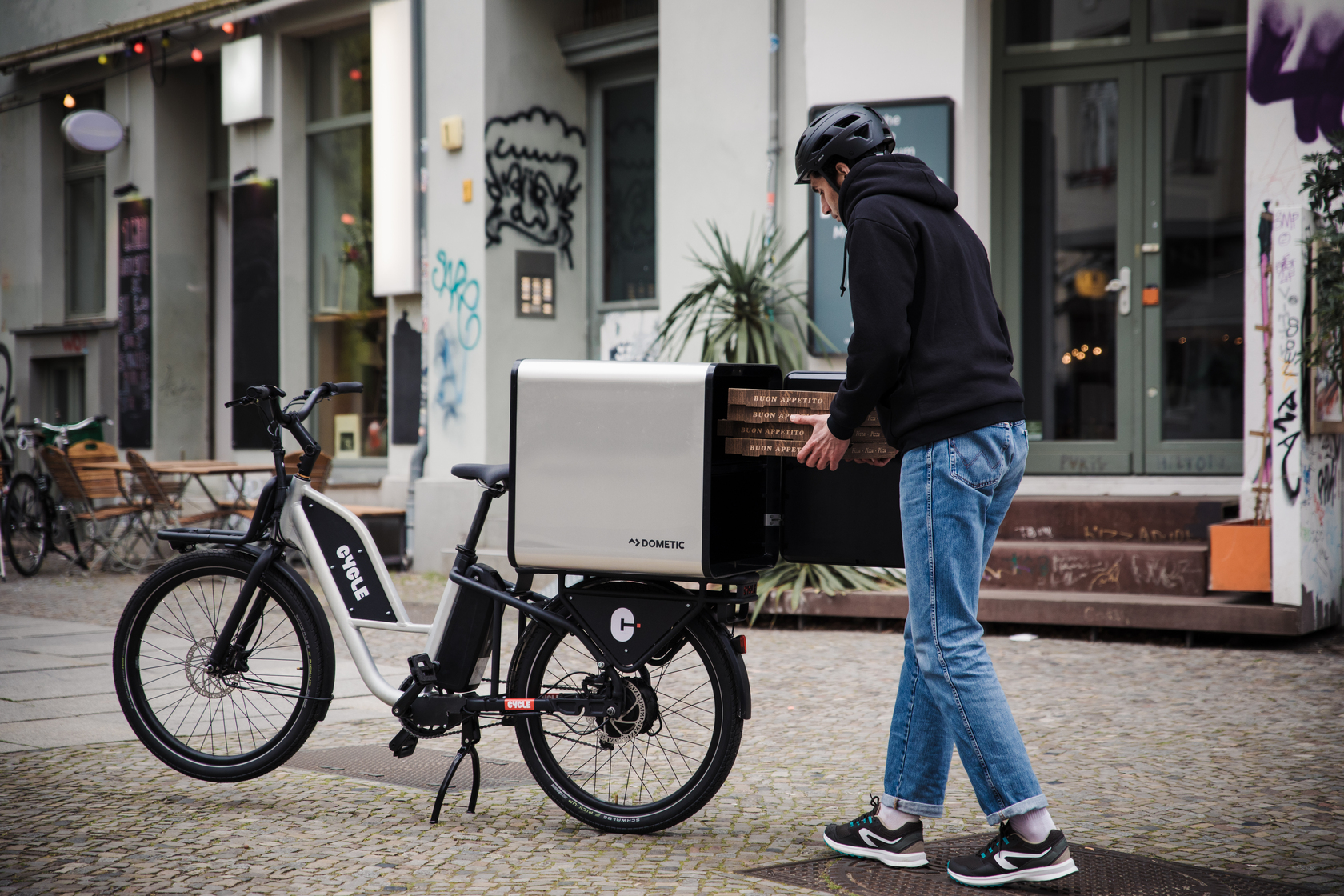

Why e-bikes belong in every urban delivery fleet
The last mile is where cities push back
The last mile is the most expensive, most frustrating part of any delivery. It is where a van meets a one-way street, a full loading bay and a low-emission zone, all before the driver has found somewhere to stop.
Cities are not getting easier to drive in. Across Europe, centres are adding car-free streets, congestion charges and stricter emission rules every year. Meanwhile customers expect their dinner in 25 minutes and their parcel the same day.
For delivery operators, that tension has a clear answer on two wheels. At CYCLE, we see it every day: more than 10,000 of our e-bikes are on the road daily, and professional riders cover over 200 million kilometres a year on them.
Faster, cheaper, cleaner: the case in numbers
Speed. In dense centres, bikes simply move faster. A University of Westminster study of central London found cargo bikes delivered 7 parcels an hour against 4 for vans, 1.61 times faster. The reasons are practical: bikes filter through traffic, use cycle lanes and shortcuts, and stop right at the door instead of circling for parking.
Cost. An e-bike has no fuel bill, no congestion charge and no parking fines. Charging a battery costs cents, not euros. And a rider needs no commercial driving licence, which widens the pool of people you can hire.
Emissions. The same study found e-cargo bikes cut CO₂ by 90% compared with diesel vans, and by 33% even compared with electric vans. That matters when your clients report on their supply-chain emissions, and when the city decides who may enter the centre.
Access. Low-emission zones, pedestrianised streets and time-restricted areas are closed to vans. They are open to bikes.
The honest caveat: bikes do not beat vans everywhere. A UPS pilot in Seattle found trucks still carried more on its routes. E-bikes win on short, dense, high-frequency trips, which is exactly what food delivery, quick commerce and inner-city parcels are.
What really holds fleets back
If the numbers are this clear, why isn't every fleet electric and two-wheeled already? In our conversations with operators, the bike itself is rarely the problem. Running a fleet of them is.
- Downtime. A courier with a flat tyre or a faulty battery earns nothing and delivers nothing. Every hour off the road is lost revenue.
- Maintenance at scale. Keeping hundreds of bikes roadworthy needs mechanics, spare parts and workshops in every city you operate in.
- Theft. E-bikes are valuable and easy to steal. Without tracking and cover, one bad week can wipe out a month's margin.
- Upfront cost. Buying a fleet outright ties up capital that growing delivery businesses would rather spend on riders and customers.
How to start without the headaches
- Pilot one zone. Pick your densest delivery area and compare bikes against your current vehicles for a month.
- Pay per bike, per month. A subscription turns a large capital outlay into a predictable operating cost you can scale up or down.
- Make service someone else's job. Choose a partner that includes repairs, maintenance and replacements, ideally at a workshop or at the rider's door.
- Insist on theft protection and GPS. Tracking deters theft and helps recover bikes when it happens.
- Match the bike to the job. Food couriers, parcel riders and cargo loads need different range, capacity and comfort.
The fleet of the future is already riding
E-bikes are not a green side project anymore. For short, dense, time-critical urban trips they are the faster, cheaper and cleaner choice, and cities are only tilting the field further in their favour.
That is why CYCLE exists. We provide all-inclusive e-bike subscriptions for couriers and delivery companies in over 200 cities across six countries, with maintenance, repairs, theft protection and GPS tracking built in. Delivery brands including Foodora, Deliveroo, Domino's and Just Eat already ride with us.
Ready to test e-bikes in your fleet? Talk to our team and we'll help you plan a pilot in your city. Enjoy the ride, we'll take care of the rest.
.avif)

%20(2)%20(1).avif)


%20are%20the%20future%20in%20Germany..avif)


